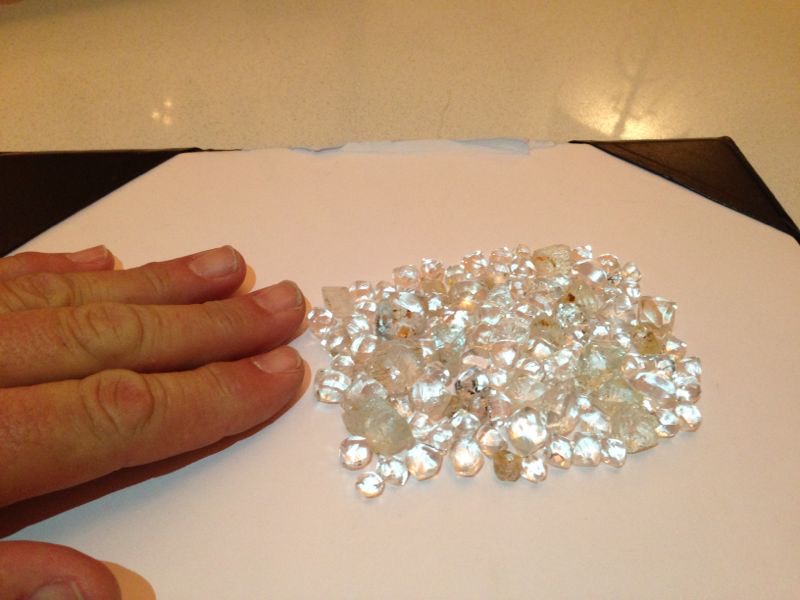
The decision behind rough-diamond evaluation
A rough diamond is not yet a finished product. Before cutting begins, the commercial task is to understand what polished options the stone may support and how the stone’s shape, surface and internal features could affect those options. The evaluation is therefore both technical and commercial: it helps frame what may be recoverable from the rough and whether a proposed purchase makes sense under the prevailing market conditions.
Scanning, modelling and proposed plans support commercial decisions by making the available options clearer before cutting begins.
Rough-diamond buying and contract work across Africa and India
Scott undertook rough-diamond buying and contract work in Namibia, the Democratic Republic of the Congo (DRC) and South Africa.
His diamond-industry work also included time in Surat and Mumbai across rough-diamond purchasing, sales, distribution and supply. He worked with rough-purchasing contracts and diamond evaluation as part of the commercial decision process.
Those activities connected sourcing the rough, assessing planning potential, considering the contractual position, reading the market and assessing commercial return.
Jewellery CAD, CGI rendering and animation
Scott entered the jewellery industry in 1996 and subsequently developed advanced capability in jewellery CAD design, CGI rendering and animation.
His software experience includes Rhino 3D, V-Ray, RhinoGold and Matrix for jewellery modelling, rendering and presentation.
Operating a Sarin evaluation system
Scott currently operates a Sarin diamond-evaluation system, manufactured in Israel, and has used it in his rough-diamond work. He used laser-assisted scanning and planning with market analysis to assess potential polished yield and commercial return.
What scanning and planning contribute
Rough-diamond systems use laser scanning to map a stone’s surface and create a three-dimensional model. Planning tools combine three-dimensional and inclusion information to compare possible polished-diamond plans.
The value of that information lies in making possible choices more visible before irreversible work begins. A model can help an operator compare planning directions and identify constraints, but the final commercial decision still depends on the quality of the available data and the judgement applied to it.
Potential yield and potential value are different questions
Potential polished yield concerns how much usable polished material a plan may recover from the rough. Commercial value asks a broader question: whether the proposed polished outcomes are likely to justify the rough cost, processing exposure and market risk. A plan that appears attractive by weight alone is not automatically the strongest commercial option.
Scott used scanning and planning information with market analysis to assess both potential polished yield and commercial return.
Why market analysis sits beside technical analysis
Market demand sits alongside the characteristics of the rough and its inclusions when possible polished outcomes are assessed.
Scott used market analysis to understand how possible polished outcomes related to commercial performance.
Contracts and commercial discipline
Contract evaluation was part of Scott’s rough-diamond work. Technical information is most useful commercially when it is considered with the purchase terms, the obligations being accepted and the assumptions behind the proposed transaction.
This creates a disciplined sequence: establish what the available scan and planning data can support, distinguish assumptions from known information, compare possible outcomes with the market context and then assess the transaction on its terms. The process does not eliminate risk; it makes the basis of the decision clearer.
Diamond enterprise experience
Scott co-owned Dhanalakshmi Shri Diamonds Private Limited in India and served as a director from its incorporation in May 2013.
In Australia, Omnia Australia Pty. Ltd. traded as Omnia Diamonds. Scott served as a director and co-owner of the Omnia enterprise and later co-owned Brisbane Diamond Company.